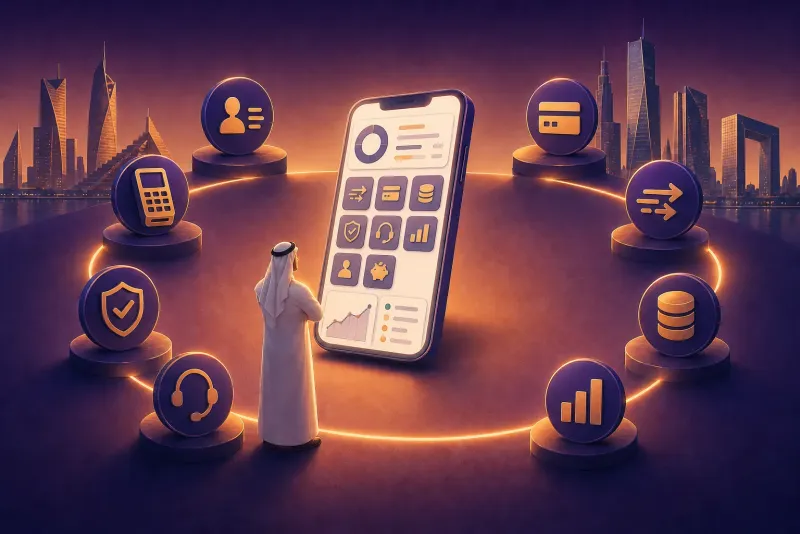
In plain words
SARIE is the motorway system that Saudi riyals travel on between banks. When you send money from your account at one Saudi bank to a friend at another, SARIE is usually what carries it. It is one of the national payment systems owned by SAMA, the Saudi Central Bank. 1
The name covers two things. The original SARIE is a real-time gross settlement system that Saudi banks have used since the late 1990s to settle payments with each other, one by one, in central bank money. In 2021 SAMA added an instant payment service under the same name, which its website now writes in lower case as “sarie”. 1
For most people, the instant service is the one that matters. It sends money between Saudi bank accounts in seconds, 24 hours a day, every day of the year. You do not even need the recipient’s IBAN: a mobile number or national ID number linked to their account is enough.
How it works
How a sarie instant transfer works
What the sender sees in the app, and what happens between the banks.
-
1
The sender enters a mobile number
Or an IBAN, national ID, residence number or email, in their banking app.
-
2
The recipient’s name is checked
The system finds the linked account and lets the sender verify the beneficiary’s name before the money leaves.
-
3
SARIE routes the payment
The sending bank passes the payment to the national system, which forwards it to the receiving bank.
-
4
The money arrives in seconds
The recipient’s bank credits the account straight away, at any hour, on any day.
The two sides of SARIE
Founders often see the name in two different contexts. This is how they differ.
| High-value settlement (RTGS) | Instant payments (sarie) | |
|---|---|---|
| Main use | Large and urgent payments, and settlement between banks | Everyday transfers between people and businesses |
| Speed | Settled one by one, in real time, during operating hours | Seconds, 24/7, all year |
| How you address the payment | Bank account details | IBAN or an alias such as a mobile number |
| Amounts | Large values | Lower values, up to a maximum per transfer set by SAMA |
| Who uses it directly | Banks | Banks, on behalf of their customers |
At the time of writing, SAMA describes the instant service as designed for transfers of up to SAR 20,000, and it lets customers send smaller amounts to new recipients without first adding them as beneficiaries. Limits change, so check SAMA’s page before you design around them. 1
SAMA also says the instant service follows ISO 20022, the global standard for payment messages, which helps it connect with other instant payment systems in future. 1
What SARIE means for a fintech
Lets you
- Pay out to any Saudi bank account in seconds
- Let users top up a wallet by instant transfer
- Offer send-to-a-phone-number transfers
- Confirm the recipient’s name before sending
- Settle with suppliers and merchants outside banking hours
Direct participants are mainly banks. Most fintechs, including licensed payment and e-money firms, connect through a partner bank, so the speed and features your customers get depend partly on that bank’s integration.
What to plan before you build on it
Adding instant transfers to a Saudi product is more than one API call. These are the parts teams most often underestimate.
Partner bank
Which bank connects you, what its API supports, how it reports each payment’s status, and what it charges.
Aliases and names
Screens that accept a mobile number or ID, show the verified name, and explain clearly when no account is linked.
Limits and fraud checks
Lower limits for new recipients, real-time transaction monitoring, and a way to pause suspicious transfers before they leave.
Ledger and reconciliation
Every transfer recorded in your ledger with a unique reference, so it can be matched against the bank’s records each day.
Round-the-clock operations
If money moves at 2am, someone or something has to watch failures, refunds and complaints at 2am too.
For what else needs to change when you add Saudi Arabia to a Gulf product, see the GCC expansion configuration matrix.
Equivalents in the UK, EU and UAE
Most large economies now run both a high-value settlement system and a separate instant payment system. Here is how SARIE lines up.
| Market | High-value settlement | Instant payments |
|---|---|---|
| Saudi Arabia | SARIE RTGS | sarie instant |
| United Kingdom | CHAPS | Faster Payments |
| Euro area | T2 | SEPA Instant |
| UAE | UAEFTS | Aani |
The idea is the same everywhere, but limits, aliases, operating rules and access for non-banks differ in each country. A product built for one should treat each rail as a separate integration.
SARIE itself stays inside Saudi Arabia. Money that crosses borders travels on other channels, such as AFAQ, the shared settlement system for payments between Gulf countries, or correspondent banking for the rest of the world. If your product sends money abroad, plan those routes separately from your domestic transfers.
Example: same-day payouts for gig workers
Faisal runs a delivery app in Riyadh. His couriers want to be paid at the end of every shift, not once a week.
- The old way. Weekly batch payments meant couriers waited days and called support when money was late.
- The change. Through his partner bank, Faisal sends each courier’s earnings by sarie the moment a shift closes, to their IBAN or registered mobile number.
- The checks. Before the first payout to a courier, the app confirms that the name on the receiving account matches the courier’s profile, which cuts misdirected payments.
- The result. Couriers see the money within seconds, even on a Friday night, and Faisal’s finance team reconciles each payout against a single reference.
Common misconceptions
“SARIE is only for big bank transfers.”
That was its original role. Since 2021 the instant service carries everyday payments between people and businesses, around the clock.
“Instant means there is no limit.”
The instant service has a maximum amount per transfer. Large payments still go through the high-value side.
“Any licensed fintech plugs straight in.”
Most connect through a partner bank. Plan your integration, costs and timelines around that bank.
FAQ
What is SARIE in Saudi Arabia?
SARIE is the Saudi Arabian Riyal Interbank Express, the national payment system owned by the Saudi Central Bank (SAMA). It settles payments between Saudi banks, and its instant service lets people send riyals to another bank account in seconds, at any time.
How long does a SARIE instant transfer take?
Usually a few seconds. The instant service runs 24 hours a day, every day of the year, including weekends and public holidays.
Can I send money with SARIE using a mobile number?
Yes. As well as the IBAN, the instant service accepts alternative identifiers such as a mobile number, national ID or residence number, email address, or a company's unified number, once the recipient has linked them to their account.
Is there a limit on SARIE instant transfers?
Yes. The instant service is designed for lower-value transfers, and SAMA sets a maximum amount per transfer. Larger payments go through SARIE's high-value side. Check SAMA's website or your bank for the current limits.
Can a fintech connect directly to SARIE?
Direct participants are mainly banks. Most fintechs, including licensed payment and e-money institutions, reach SARIE through a partner bank, unless SAMA grants them their own access.
What is the difference between SARIE and mada?
SARIE moves money between bank accounts. mada is the national debit card network that handles card payments at shops, ATMs and online. A Saudi product often needs both.
Sources
-
1
SC
Saudi Central Bank National payment systems: sarie
https://www.sama.gov.sa/en-US/payment/Pages/SARIE.aspx -
2
SC
Saudi Central Bank Saudi Central Bank (SAMA)
https://www.sama.gov.sa/en-US/Pages/default.aspx